Narvaez, D. (September, 2026). The Characteristics and Cultivation of Species-Normal Moral Character. International Society for Moral Psychology, Cornell University, Ithaca, NY.
ABSTRACT: Species-normal evolved baselines for development and functioning are used to discuss human behavior using Philippa Foot’s framing for assessing an organism: its essential nature, its development, the qualities that help the organism lead a full life, and the capacities that make it a proper member of its species. For the vast majority of our 300,000-year existence, humanity has lived communally nested (recently culturally derailed), with now empirically-verified positive effects on wellbeing and morality.
Keynote (September, 2026). The Evolved Nest. Raised Good Sleep Training Summit (online).
Keynote (May, 2026). Evolved Nestedness across the Lifespan Promotes Wellbeing. New Jersey Integrated Mental Health Network. Asbury Park, NJ.
ABSTRACT: In contrast to the trauma-inducing pathway humanity is currently on, our species evolved a wellness-informed pathway that focuses on meeting basic needs through deep nestedness. It begins with the Communal Evolved Nest which includes Nature immersion, regular healing, free social play, responsive relationships, positive touch, welcoming social climate, multiple nurturers, soothing perinatal experiences, and child-directed breastfeeding. The millions-years-old Communal Nest promotes health and wellbeing throughout the lifespan, beginning with nurturing by mothers and others, following the maternal gift economy of fulfilling basic needs.
Deep Nestedness also includes Intergenerational Nestedness that honors ancestral wisdom, human and nonhuman, and the wellbeing of future generations, and Cosmic Nesting practices that maintain a sense of rootedness in Earth’s cycles and systems. Nestedness throughout life fosters an integrated self, where heartmindedness predominates and the Indigenous/kinship worldview guides behavior. Nested communities partner with the ecological community, promoting flourishing in All.
Keynote (March, 2026). Ethical Skills and Virtuous Character in the Nested Classroom. Advancing Character Across the Curriculum annual conference, Tempe.
ABSTRACT: Moral formation is initiated at the beginning of life with the shaping of neuronal systems towards patterns of health and virtuous cooperation or towards dysregulated disorder and self-protection. Nurturing families and communities support embodied prosocial moral/ethical capacities. Ethical behavior is comprised of a set of processes and capacities for ethical sensitivity, ethical judgment, ethical motivation/focus, and ethical implementation. A well-nurtured species-normal engagement ethic embraces the full complement of prosocial capacities. In contrast, protectionist ethics curtail such capacities, narrowing perception, affordances (action possibilities), and motivation. What can schools and classrooms do to enhance capacities for ethical behavior? The Minnesota Community Voices and Character Education project (CVCE) identified sets of skills in the four areas that can be incorporated into regular academic instruction. Ideally, educators follow natural pedagogy, a community-based immersion with mentors who help students build experiential knowhow. Setting up nurturing schools and classrooms that align with our species’ Evolved Nest supports the growth of ethical capacities, specifically, prosocial morality.
Nested classrooms are both trauma-informed and wellness-promoting in that students are helped to develop self-calming routines, trusting relationships, prosociality, and an expanded communal imagination through the provision of our species-normal Evolved Nest. These include the encouragement through structures and practices of a welcoming social climate, responsive relationships with adults and peers, extensive opportunities for self-directed learning and play; routine healing rituals such as class meetings and conflict resolution practices; and immersion in the natural world to build ecological attachment and respectful relations with the other than human. Ethical instincts and virtuous character are cultivated over time through the development of multiple skills and embodied intelligence.
In nested classrooms, students learn skills for individual and community flourishing that include the biocommunity. The ancestral wisdom of the Evolved Nest includes regular joyous group activities like song games, dancing, and dramatic invention. Restoring the Evolved Nest helps reestablish a healthy, compassionate human nature.
The nested classroom adds a wellness-informed approach to moral education. Many students arrive at school having experienced little of the evolved nest, showing signs of distress and impaired learning.
Keynote (November, 2025). Our Maternal Model. Maternal Gift Economy Annual Conference, online.
Tarsha, M. & Narvaez, D. (August 2025). Evolved nest experience and the development of child wellbeing, prosociality and morality. Association for Moral Education annual conference, Tampere, Finland.
ABSTRACT: This paper highlights the critical role of early life experience of the evolved nest for the optimal development of children’s wellbeing, sociality, and morality. The Evolved Nest is the ecological system of care that evolved to meet basic needs and, according to converging evidence across the sciences, shape good health and a prosocial personality. For years, our lab has been examining evolved nest components and their effects on children (3-8 years old). Multi-informant, multi-method, multi-national findings from longitudinal and cross-sectional studies demonstrate the importance of evolved nest experience for sociomoral development.
Narvaez, D., & Malthouse, E. (August 2025). Nested care and prosociality across generations: a longitudinal survey. Association for Moral Education annual conference, Tampere, Finland.
ABSTRACT: This paper shows how nested care can explain the transmission of ethical and sociomoral orientations across generations. Drawing on Triune Ethics Meta-Theory, we use longitudinal data collected in the US over an eight-year period to show that early life experience of the evolved nest is associated with an orientation towards social engagement and cooperation in adulthood. At the same time, we show that a lack of nested care is associated with an orientation towards social detachment and competition. Lastly, we show that these orientations are passed onto the next generation – from parent to child – through either nested or unnested care.
Narvaez, D. (August, 2025). The nested classroom. Workshop for Association for Moral Education annual conference, Tampere, Finland.
ABSTRACT: Evolved Nesting updates the RAVES approach (Relationship-Apprenticeship-Virtuous-models-Ethical-skills-Self-authorship) stressing ancestral wisdom where optimal moral development is the aim. Students develop self-calming routines, trusting relationships, compassionate action skills, and an expanded communal imagination. They have extensive opportunities for self-directed play and immersion in the natural world to build ecological knowhow, ecological attachment and respectful relations with the other than human; routine healing practices such as class meetings and conflict resolution practices; and regular joyous group activities like song games, dancing and dramatic invention. In these sustaining classrooms, students learn skills for individual and community flourishing that includes the ecological community.
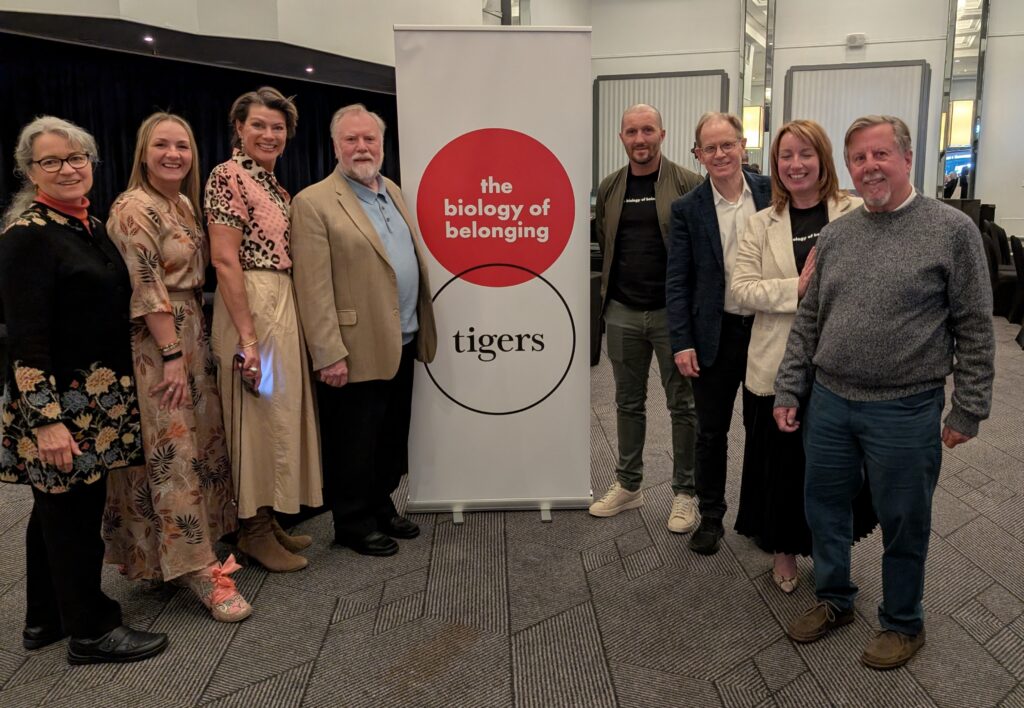
Keynote (May, 2025). The Evolved Nest: Our Wellness Pathway. Biology of Belonging conference. Glasgow, Scotland.
ABSTRACT: The wellness-informed pathway focuses on meeting basic needs. Our species’ developmental nest evolved to meet the basic needs of babies and children. Evolved nest components include soothing perinatal experience, extensive on-request breastfeeding and affectionate touch, allo-mothers who provide responsive care and a welcoming climate, self-directed social play in the natural world which develops nature connection, and routine healing practices. Evolved Nest components are particularly important in the first few years of life when a child’s neurobiology is being shaped towards a wellness-promoting trajectory of health and sociality, or trauma-inducing trajectory of ill health and self-absorption. Evolved Nest provision is an ethical imperative.
Keynote (May, 2025). Restoring Deep Nestedness for Human and Planetary Wellbeing. Psicologi Istanbul conference, “The Healthy Nest,” Istanbul, Turkey.
ABSTRACT: What are the natural needs of babies for optimal growth and development? How are the changes in modern life affecting childraising? What does the evidence from evolutionary psychology, anthropology, and neuroscience tell us about ensuring the healthy development of babies? What are the forms of care that children biologically need? How does modern child raising compare with traditional child raising approaches? How do secure relationships and early caretaking processes shape a child’s development?
Keynote (May, 2025). The Evolved Nest: The Only Future for Humanity? Division 24, American Psychological Association, Pittsburgh, PA.
ABSTRACT: Why is humanity destroying its wellbeing and its habitat, Earth? The suggestion here is that the dominant culture has unnested itself from humanity’s millions-year-old adaptive heritages, impairing evolved capacities and human potential in a feedback loop across generations of greater disconnection and destruction. We can find humanity’s heritages in practices of hunter-gatherer civilization, traditional Indigenous/First Nation communities. Humanity’s heritages are to be (1) nested horizontally: respectful of deep history, ancestral wisdom, and living with future generations in mind; (2) nested developmentally: immersed in evolved ways of raising children to foster thriving and nesting practices that maintain a cooperative human nature throughout life; and (3) nested vertically: consciously participating as stewarding partners in the Earth-cosmos dynamism. Deep nestedness fosters capacities that are often missing in westernized peoples: ecological relational consciousness and ecological relational knowhow, which were central to human adaptation. The dominant culture undermines their development.
Mainstream western scholarship has accepted the slippage in baselines, collaborating with industrialized-capitalism culture and its intentional divorce from Nature’s ways, and is now caught and caged in the limitations of its models and metaphors. Enmeshed in the dominant culture, modernist psychology largely ignores species-normal child raising, species-normal human nature and species-normal capacities found all over the world among nomadic foraging societies and other traditional societies. In order to reverse the dominant culture’s destruction of planetary integrity, biological and cultural diversity, psychology must transform itself to help reestablish evolved baselines and support deep nestedness. In this way, psychology can help restore human and Earth wellbeing.
Keynote (January, 2025). The Wisdom of Our Ancestors: Deep Nestedness and Human Futures. University of Chicago Wisdom Project. Chicago, IL.
ABSTRACT: The dominant culture has pulled away from humanity’s millions-year-old adaptive heritages, impairing species-normal capacities and potential in a feedback loop of greater disconnection and destruction. Species-typical nature is fostered by deep nestedness—developmentally, horizontally—across time/space, and vertically—in Earth and cosmos. We must re-adopted nestedness to restore human and planetary wellbeing.
Keynote (November 28, 2024). The Evolved Nest: Material Gift Economy for All. Maternal Gift Economy Salon, online.
Keynote (October 14, 2024). The Evolved Nest and Wellness-Informed Practice. La Leche League annual conference, The Art of Breastfeeding, online.
ABSTRACT: The wellness-informed pathway focuses on meeting basic needs. Our species’ nest evolved to meet the basic needs of children. Evolved nest components include soothing perinatal experience, extensive on-request breastfeeding and affectionate touch, allo-mothers who provide responsive care and a welcoming climate, self-directed social play in the natural world which develops nature connection, and routine healing practices. Breastfeeding meets multiple nest components. Evolved Nest components are particularly important in the first few years of life when a child’s neurobiology is being shaped towards a wellness-promoting trajectory of health and sociality, or trauma-inducing trajectory of ill health and self-absorption. Evolved Nest provision is an ethical imperative.
Keynote (September, 17, 2024). Returning to Evolved Nestedness, Wellbeing, and Mature Human Nature, an Ecological Imperative. 40th Annual Conference of Human Dignity and Humiliation Studies: ‘Global Vulnerabilities – From Humiliation to Dignity and Solidarity, Madrid, Spain.
Keynotes (September 1-2, 2024). Feminine Futures workshop. Schumacher College, Devon, England.
ABSTRACT: Our ancestors were deeply intelligent. About two million years ago we evolved cooperative child raising, which fosters big social brains and distinguishes us from chimpanzees. It is time to remember what our ancestors intuited and science now confirms.
- We are biosocial. That is, our biology is shaped by our social experiences and our sociality is rooted in our biology. A faulty biology leads to a faulty sociality.
- Most of our humanity is grown postnatally because humans are highly immature at full-term birth and we take 3 decades to reach maturity.
- Over millions of years humans evolved a nurturing system, the evolved nest, that fosters healthy development. The evolved nest helps babies meet basic needs for self-organization and growth, fostering thriving, resilience and unique potential.
- Our ancestors followed humanity’s Wellness-Promoting Pathway which we can still observe in hunter-gatherer societies today.
- Provide for basic needs of infants through the evolved nest. Provide for the basic needs of all throughout the lifespan.
- This leads to health at all levels (physiological, psychological and social) and optimal species nature.
- Humans then develop heartmindedness, virtuous functioning through the integration of physiology, psyche, spirit, and action. This occurs at both the individual and community levels.
- The result is a set of individuals and communal practices that are cooperative and compassionate, inclusive of other Earth entities (animals, plants, waterways, mountains) and that foster cultural perpetuity.
Keynote (July, 2024). Human Flourishing and Planetary Flourishing: The Need for Nestedness. What is (the Good Human) Life? Conference, University of Pennsylvania.
Keynote (April, 2024). Indigenous Worldview and Deep Nestedness: Practices for Wellness. Minnesota State University—Mankato. Rural Behavioral Health Lectureship series.
ABSTRACT: Why is humanity destroying its wellbeing and its habitat, Earth? The suggestion here is that the dominant culture has unnested itself from humanity’s millions-year-old adaptive heritages, impairing evolved capacities and human potential in a feedback loop of greater disconnection and destruction. One of humanity’s extra-genetic inheritances is the evolved nest, the developmental system for raising the young, comprised of common practices around the world among nomadic foragers, who represent the type of human society in which the human species spent 95% of its existence. Nine nest components are described, along with evidence supporting their importance for physiological and sociomoral wellbeing.
Keynote (March, 2024). The Wellness-Informed Pathway: Early Life Ethics and Lactation Support. New Mexico Breastfeeding Taskforce annual conference, Albuquerque.
ABSTRACT: The wellness-informed pathway focuses on meeting basic needs. Our species’ nest evolved to meet the basic needs of children. Evolved nest components include soothing perinatal experience, extensive on-request breastfeeding and affectionate touch, allo-mothers who provide responsive care and a welcoming climate, self-directed social play in the natural world which develops nature connection, and routine healing practices. Breastfeeding meets multiple nest components. Evolved Nest components are particularly important in the first few years of life when a child’s neurobiology is being shaped towards a wellness-promoting trajectory of health and sociality, or trauma-inducing trajectory of ill health and self-absorption. Evolved Nest provision is an ethical imperative.
Narvaez, D. (2024, October 24). Grounding Moral Development in Evolution, Neurobiology & Culture. Association for Moral Education, New York City.
ABSTRACT: A transdisciplinary moral psychology theory is presented. Philosophical questions are addressed with cross-discipline evidence. Questions include: What kind of creature are we? What qualities do we need to live a full life? What kinds of capacities make each a proper member of the species? What influences our development? The dominant culture has pulled away from humanity’s millions-year-old adaptive heritages, impairing species-normal capacities and potential in a feedback loop of greater disconnection and destruction. Species-typical nature is fostered by deep nestedness—developmentally, horizontally—across time/space, and vertically—in Earth and cosmos. We must re-adopted nestedness to restore human and planetary wellbeing.
Narvaez, D., & Bradshaw, G. (June, 2024). A Common Path for Revitalizing Nature and Healing Human Societies. North American Association for Conservation Biology, Vancouver.
ABSTRACT: The dominating paradigm has assumed humans are superior and separate from the rest of Nature. Science shows otherwise. Neuroscience demonstrates that Mice, Elephants, humans, and other Animals including Octopuses share common capacities for thinking, feeling and consciousness. Not only is Nature’s diversity underlain by a shared substrate of mind and body, but Animals and humans share a common developmental system for raising their young and cultivating thriving communities. Still practiced in many Indigenous communities, the “evolved nest” is an adaptive epigenetic strategy tailored over millions of years to meet psychological, social, and physical needs in a species-unique manner which optimizes wellbeing. The concept and practices of the evolved nest make critical contributions to conservation in several ways. First, they provide a road map for bringing humans back into health and resilience resonant and supportive of Nature. Second, by integrating multiple disciplines including ecology, biology, climatology, anthropology, evolutionary systems, and neuroscience, the evolved nest invites interdisciplinary insights to pressing issues such as decolonization and ecological justice. Third, the evolved nest enhances deep understanding and respect for our Animal kin. Illustrated with human and non-human examples including Gray Wolves (Canis lupus), Brown Bears (Ursus arctos), and Emperor Penguins (Aptenodytes forsteri), we identify and describe key components of the evolved nest. Through neuro- and clinical sciences, each component is associated with and vital for good health. Understanding the evolved nest practically redirects our species away from patterns of ill-health, destruction, and trauma affecting the planet today.
Keynote (November 2, 2023). The Evolved Nest, Returning to Nature’s Way of Raising Connected, Nurtured Children. Early Childhood Funders Collaborative. Washington, D.C.
ABSTRACT: Until very recently in human history, our species evolved ways of raising “nested children” – children raised with loving, affectionate, and supportive villages, and deep connections to and respect for the natural world. We have, as a society, strayed from elements of an evolved nest that respond to children’s basic needs: providing soothing perinatal experiences, extensive on-request breastfeeding; multiple caregivers who provide responsive care; affectionate touch; a welcoming climate; self-directed social play; nature immersion; and regular healing practices. We will explore the evolved nest, and these conditions and components that are particularly important in the first few years of life to shape a child’s neurobiology towards a trajectory of health and wellbeing; and reflect on how funders can support their communities, and parents and families they work with to return to a culture of connectedness.
Panelist (October 13, 2023). Early Relational Health: Forming the Roots of Connected Communities. Building Connected Communities Conference. Harvard University.
Keynote (October 9, 2023). Restoring the Evolved Nest for Our Children. Tristate Trauma Conference. Hamilton, Ohio.
ABSTRACT: Humanity evolved a system of raising children that matches up with their maturational schedule. Unfortunately, modern industrialized societies have forgotten these evolved principles, leading to the mental and physical illbeing become more and more prevalent among all ages. Our evolved nest is provided by a community and initiates a wellness-informed pathway. Evolved Nest components are particularly important in the first few years of life when the trajectory for a child’s life course is established. Evolved nestedness supports healthy neurobiological systems throughout the body and brain and shapes social capacities. We must restore the evolved nest to children and all ages instead of continuing on a trauma-inducing pathway.