
The Lived Versus the Learning Experience
Nesting Know How for Adults
The Lived Versus the Learning Experience of the Evolved Nest
Few humans have a lived experience of our Evolved Nest. Some have witnessed remnants of a lived, whole Evolved Nest presenting today as siloed, marginalized movements to support natural birth, free play, attachment parenting, or normalizing breastfeeding.
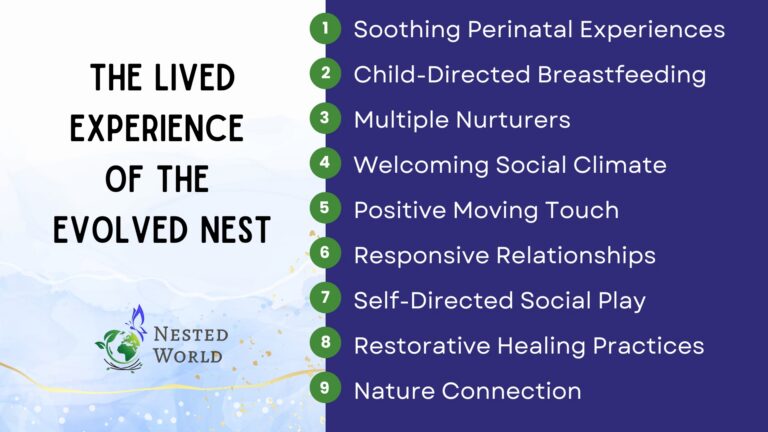
The Lived Experience of the Evolved Nest refers to the actual, immersive, species-typical way of being raised that aligns with the Evolved Nest’s nine components:
1. Soothing Perinatal Experiences
2. Child-Directed Breastfeeding
3. Multiple Mutual Nurturers
4. Welcoming Social Climate
5. Positive Moving Touch
6. Responsive Relationships
7. Self-directed Social Play
8. Regular Restorative Healing Practices
9. Nature Immersion, Connection and Parnership.
Our Lived Experience of the Evolved Nest shapes human neurobiology, worldview, morality, and relational capacities. It is grounded in experience—how the nest is lived across a lifetime, leading to cooperative companionship, resilience, and kinship awareness.
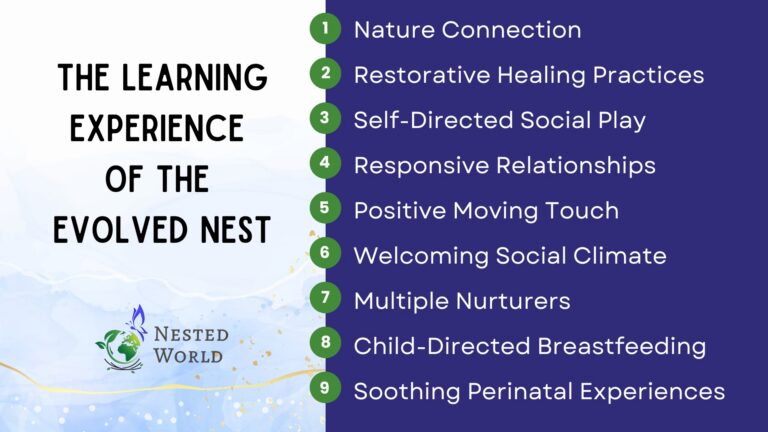
The Learning Experience of the Evolved Nest reverses the order of the nine components to create a trauma-informed, pedagogical framework. By sequencing for nervous system safety first, the reversed order of the nine components honors lived realities (including potential wounds) while equipping trainees to deeply engage the science and worldview.
The Learning Experience of the Evolved Nest starts with Nature Connection, Restorative Healing Practices, and Play, alongside worldview literacy. This approach builds skills and awareness for regulation, safety, co-regulation, and tools first, enabling participants to engage with the more potentially challenging material (e.g., recognizing what was missed in modern childrearing, personal or cultural gaps, or perinatal experiences) without re-traumatization.
This intentional, safe pathway emphasizes epistemological tools—how we come to know and integrate the science of the Evolved Nest—worldview literacy, skill-building, reflection, and trauma-informed practices.
The Learning Experience of the Evolved Nest’s epistemological approach considers knowledge acquisition methods, foundations, validity, and limits of knowing. The Learning Experience does this by:
- Front-loading safety and resource-building. The curriculum includes polyvagal-informed regulation though connection to nature as a reliable anchor, restorative practices for self-regulation, play for embodiment and joy, as well as a capacity for imagining a different future for humanity.
- Creating a structured curriculum with reflective practices, community support, optional elements, choice/consent, and feedback loops—making abstract science and Indigenous Kinship precepts accessible and integratable.
- Bridging the Theory-Praxis Gap: Ambassadors gain tools to know the material cognitively and experientially, then translate it into personal integration, projects, and decentralized change with Nested Kinship as the unifying framework.
During the Nesting Ambassador Program, we will explore and reclaim our human family’s birthright to living connected, peaceful, and thriving lives. We will support one another, care for our hearts, bodies, minds, and spirits on the journey and prepare a plan for sharing, re-centering, and bringing to life our communal evolved nest. By the time we become Certified Nesting Ambassadors, we will be resourced and ready to inspire others to re-imagine our world.
Throughout the course of the program, we develop the capacity to steward a new future of humanity, with agency and knowhow based on Evolved Nest science, integrity based on Kinship Worldview values, and compassion based on the integration of EN/KW’s ancient wisdom. As Certified Nesting Ambassadors, we are ready to author a New Story of the Human Family.
Lisa Reagan is the co-founder of the Nested World Initiative, the founder of Kindred World, and the editor of Kindred Magazine. Read her work and listen to podcasts here.
the learning experience of the evolved nest
Nesting Know How for Adults: Resources for Each Component
Nesting Know How for Adults: Resources
1. NATURE IMMERSION
When you get to know Nature, you learn your own nature—your deeper self, your Spirit.
- 28 days of nudges to Nature connection (EcoAttachment.Dance)
- Find a regular place to sit still to watch, observe & listen to Nature with all senses.
- Go sunning or earthing (lying on the ground).
2. RESTORATIVE HEALING REBALANCING PRACTICES
We all need daily restorative healing and rebalancing.
- 28 Days of nudges for Self-Calming
- Keep a gratitude journal.
- Practice vagal self-regulation:
- Breathwork: Extend your exhale, activating relaxation; intentional inhale gives an infusion of energy.
- Touch: Hand-on-Heart touch for self-compassion and stress reduction
3. SELF-DIRECTED PLAY NEEDS
Free play is how we grow our right brains and their flexibility and calmness.
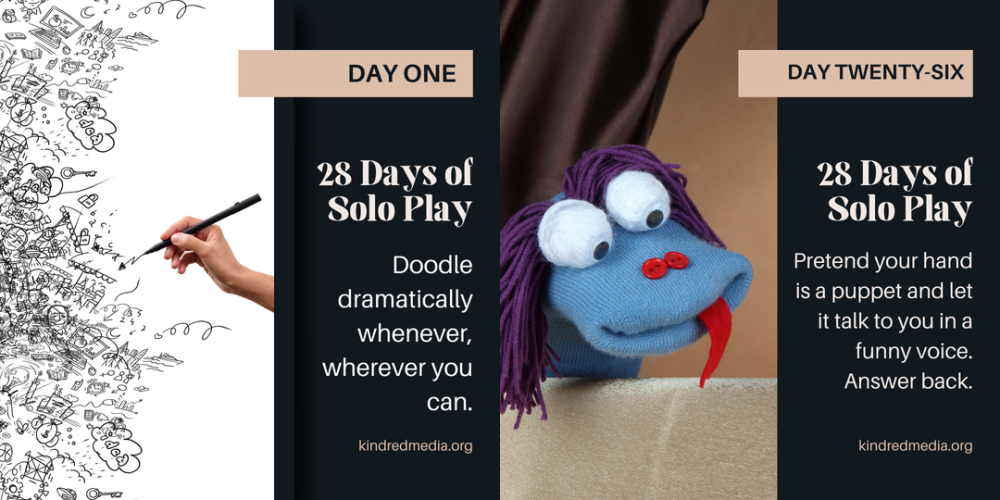
- 28 Days of nudges for Solo Play
- 13 Days of nudges for Spontaneous Joy
- Build in daily free play time with music, dance, the arts, silliness.
4. RESPONSIVE RELATIONSHIPS
Everyone needs a confidant, someone who listens.
- With family and friends, take time to talk together about the experiences of the day.
- Set up a regular time to hold and really listen to one another.
5. WELCOMING
A sense of belonging is linked to wellbeing.
- Take risks to connect to and help others.
- Help people you meet feel welcome with a smile, a hello, small talk.
- Help others contribute to the wellbeing of the family as they are able.
- Practice daily kindness.
6. MULTIPLE MENTORS
We need nurturers and mentors throughout life to guide us along the way.
- Find a mentor for areas where you want to improve.
- Participate in a larger community (e.g., church/synagogue/temple, neighborhood).
- Develop a skill to share (protective factor in adolescence).
- Mentor others with your skills and gifts.
7. AFFECTIONATE TOUCH
Positive touch helps establish healthy neurobiology and thriving.
- Cuddle with a person or pet (or stuffed animal or pillow).
- Hug a tree or lie on the earth.
- Develop habits of greeting friends with a hug.
8. CHILD-DIRECTED BREASTFEEDING
WHAT MOTHERS CAN DO:
· Provide the breast whenever the baby indicates rooting and other signals of need for the breast. This is part of responsive parenting described in component 6.
· Don’t make the baby wait or stress hormones start to flow, which slow down growth.
· Breastfeed for at least a year if not for 4 or 5 years as in most species-normal societies. The World Health Organization and the American Academy of Pediatrics recommend at least two years. Of course, you’ll have to set up your life to be able to do this.
WHAT EVERYONE CAN DO:
· Support breastfeeding as normal, natural, and necessary for lifelong health.
· Expect and support breastfeeding of toddlers.
· Expect and support breastfeeding in public spaces.
· Speak up for breastfeeding at work.
· Educate yourself about the importance of breastfeeding (links further below).
9. SOOTHING PERINATAL EXPERIENCES
WHAT MEDICAL PERSONNEL CAN DO:
- Get acquainted with natural births (no medical interventions) to have an appropriate baseline for assumptions of what is normal.
- Remember that babies vary in gestational residence by about 50 days. So the “due date” is a guess and does not necessarily match up with a particular baby’s developmental course.
- Understand that mother and baby evolved to share a dance of hormones that guide the birth experience so as not to overstress either.
- Avoid rushing labor (which may mean changing hospital practices) which stresses the fetus and can lead to long term problems outside the purview of the birthing unit.
- Adopt Baby-Friendly Hospital practices.
- Do not push infant circumcision (which has long term physiological and psychological consequences).
- Focus on maintaining a nurturing relationship between mother and child with minimal interference.
- Avoid:
- Separating baby from mom after birth
- Exposing the neonate to bright lights, chemical smells, rough touches
- Painful procedures (scrubbing baby, poking with needles, eye gel)
WHAT EXPECTANT MOTHERS CAN DO:
- Relax during pregnancy as much as possible.
- If at all possible, prepare for a naturalistic birth in a birthing center.
- Avoid social and emotional stress because it gets transferred to the baby.
- Avoid trauma and induced pain to baby at birth which come from:
- Circumcision (causes PTSD in many children, plus long term physical and psychological impairments). See Doctors Opposing Circumcision for lots of information.
- Avoid environmental toxins (air, food, water, consumer products) which can not only impair brain function and intelligence, but make one feel less well and socially withdrawn. Environmental Working Group has lists of product ratings.
WHAT NEW PARENTS CAN DO
· No matter how pregnancy and birth went, make sure to keep baby with you after birth, preferably skin-to-skin. Baby needs to reconnect to mother after the separation experience.
· Take the time to learn the signals of the child in the first days and weeks after birth.
· Honor the child’s needs and treat them as if they are still a fetus—recognizing and meeting their needs right away to keep them in a calm state.
What To Look For In A Nested Life
Find checklists for Evolved Nest Living below...
Evolved Nest Living
What To Look For In A Nested Life
The nest is a lifelong need. Although we don’t need to be carried past childhood, we still need things like affection and positive social support—feeling like we belong—as well as community membership and involvement.

Checklist for Adulthood
Here are proven practices that facilitate mental and physical health.
DAILY PRACTICES
- Laughing in delight
- Being playful with others
- Getting good sleep (in the dark to prevent cancer)
- Being physically active
- Mindfulness
- Attending to the beauty of the natural world
- Eating well and enjoying healthy food
- Expressing creativity(for me: cooking, writing, playing music, singing, writing poems)
- Caring for others and getting caring when you need it
- Practicing gratitude
- Enjoying uplifting experiences that take you beyond yourself (e.g., music, religious or spiritual practices)
GENERAL PRACTICES
- Confiding in at least one close friend (most days)
- Not succumbing to temptations too frequently (like dessert!) and learning not to feel tempted
- Maintaining practices that foster positive self-development-learning to prefer what is good and healthy
- Finding a mentor for areas where you want to improve
- Knowing how to let go and put annoying things in perspective
- Find ways to gradually increase in efficacy and competence for the things you want to accomplish (take small steps; chip away)
SOCIAL LIFE
- Having at least one close loving relationship (after learning to appreciate closeness)
- Having a group of people on whom you could rely if needed
- Having at least one confidant who can help you over rough patches
- Taking risks to connect to and help others
- Mentoring others with whatever knowledge, skills and wisdom you have
- Doing kind things for others whenever you can
- Making amends with those you have wronged or who have wronged you
FEELINGS
- Feeling like you are making a valuable contribution to the community
- Feeling like others care for you (practice compassionate meditation that starts with compassion towards yourself)
- Being in touch with your heart feelings
- Using healthful ways to calm yourself down from anxieties, fears, and angers
- Not desiring too much
- Forgivingoneself and others
- Doing things that foster prosocial feelings in yourself instead of angry or contemptuous feelings
GOALS AND MOTIVATION
- Start the day reviewing your values
- Start the day with a positive purpose that reaches beyond yourself
- Meaningful vocation (work) or avocation (activity outside work)
- Foster feeling connected to the community
- Foster nature connection–feeling in relationship to other lives in the natural world

View our trilogy of films
Step Onto Your Path of Nestedness

Reimagining Humanity
Take a step into the world of Deep Nestedness. See what it looks like…
Watch the 12-minute Reimagining Humanity film and discover resources for self-study and communal learning.

Evolved Nest
It takes a village to raise a child.
See what the Communal Evolved Nest looks like for children…
Watch Evolved Nest film in English, German, or Spanish, then discover resources for self-study and communal learning.

Breaking the Cycle
Flummoxed by today’s culture?
Learn about our ancestral community wisdom.
Watch Breaking the Cycle film in English, German, or Spanish, then discover resources for self-study and communal learning.
want to do more?
Become a Nesting Ambassador
The Evolved Nest and Kinship consciousness represent the ways all our deep ancestors lived and understood the world and their place in it. They arise from a holistic Living Earth consciousness, which is sorely needed today.
Join us as an active participant in the planet’s arising immune system!

Get Involved, Create Community
Join our private, dedicated social media platform on Mighty Networks at Kindred Community! Find Trance-breakers, Wayfinders, and New Cycle Makers. Receive notices of LIVE discussions. You will need to prove you are not a robot to join.
Are you already a part of the New Story of the Human Family? Share in our work, join our online communities, and follow the unfolding of our vision of a Wisdom-based, Wellness-informed Society in Kindred and the Evolved Nest's newsletters.

